Steve Almeroth — piecing together seven generations of my family from records, old photographs, and the stories we still carry. Corrections and additions always welcome.
👪 Family? There's a private family view with living relatives & more detail, behind a shared password. Open the family view → Ask me for the password.
Part I — My father's people (the Almeroth grandparents)
Chapter 1 — The German roots: August Almeroth of Hesse
My great-great-grandfather August Almeroth was born in May 1837 in Hesse —
Hessen, one of the German states two generations before there was a single Germany. He
was born under the older, longer spelling of our name, Allmeroth, with two L's — the
form still found today in its heartland around Kassel, in northern Hesse.
In 1867, about thirty years old, August crossed the Atlantic in the broad wave of
Germans leaving Hesse and the neighboring states for land and work in America. The next
year, 1868, he married Johanna "Hanna" Schmidt — born 19 March 1843 in
Cassel (Kassel), the same corner of Hesse he came from. They had reached America the
same year, 1867; whether they knew each other in the old country or met among fellow
immigrants, the marriage kept the family rooted, one more generation, in the people of
Hesse.
They settled in Laughery Township, Ripley County, Indiana — a heavily German,
Catholic-and-Lutheran farming county in the southeast of the state — and by the 1880
census had a full house of seven children, born between about 1868 and 1880:
George (1868), Leonhard (1869), Peter James "Pete" (1872, Napoleon, Indiana) — my
great-grandfather — John (1874), Anna (1875), Elizabeth (1876), and Martha (1880).
Somewhere in America the double-L quietly fell away and Allmeroth became Almeroth —
the small Americanization so many immigrant names went through. By 1900 the family
had left the Ripley County farmland for the city: August and Johanna appear that year in
Indianapolis (Marion County), and there they stayed. August died in 1917 in
Indianapolis, eighty years old; Johanna outlived him to 1926, dying at eighty-three.
The two of them lie together at Crown Hill Cemetery in Indianapolis — a Hessian couple
at rest in the middle of Indiana.
Sources: every name, date, and place is drawn from the family dataset and the
August Almeroth research dossier. The exact Hessian
town of August's birth is still unknown — and now we know why it's stubborn: the
community family tree simply stops at August, listing no parents, so the next step
isn't more tree-climbing but an off-tree record — his 1867 ship manifest, a U.S.
naturalization, or a Kassel-area parish baptism (a documented Allmeroth family in
Elmshagen, near Kassel, is the leading lead).
Chapter 2 — The Irish roots: the Dwyers of Tipperary and Galway
The Irish side reaches me through my great-grandmother, Elizabeth Frances Dwyer —
and behind her stand two people who carried the family out of Ireland.
My great-great-great-grandparents were Patrick Dwyer, born 20 December 1831 in
County Tipperary — the O'Dwyer country of Munster — and Catherine Madden, born in
1837 in County Galway, in the Madden heartland of Connacht. Two corners of Ireland,
two old Gaelic names — Ó Duibhir and Ó Madáin — joined in one marriage.
For a long time the tree had this generation wrong: it carried a "Cornelius Dwyer and
Mary Bogan" who supposedly never left Ireland. The records corrected both the names and
the story. Patrick and Catherine were not the old country left behind — they
crossed too. Catherine was already in Chicago by 1870, and Patrick lived out his
days there, dying after 1900; Catherine died in Chicago on 25 November 1909. The
whole Dwyer family had pulled up and gone to America together in the post-Famine decades.
Which means their son John Joseph Dwyer — born 25 November 1855 in Ireland — most
likely made the crossing as a child, not as a lone young immigrant. He grew up around
Chicago, married Anna O'Malley (born 1856 in Ireland), and on 12 November 1884
their daughter Elizabeth Frances Dwyer was born in Illinois — the first of this
line born American.
The family settled into the booming Midwest the way Irish-Catholic families did. Anna
died in Chicago in 1907; John lived until 1923, dying in Gary, Indiana — the
steel town at the bottom of Lake Michigan. Elizabeth would carry the Irish line into the
German one in 1904 (the next chapter), and was buried, a devout Catholic, at All Saints
Catholic Cemetery in Des Plaines.
Sources: drawn from the family dataset and the
Irish-line research dossier. The two counties —
Tipperary for the Dwyers, Galway for the Maddens — are now confirmed on Patrick's
and Catherine's own records; the exact parishes are the next thing to chase (Irish civil
registration runs from 1864, and the parish registers go back further). Patrick's and
Catherine's own parents are still unknown — the oldest names this Irish line can yet
reach.
Chapter 3 — Two worlds meet: Chicago, 1904
On December 21, 1904, in Chicago, the two streams of this story finally ran
together. Peter James "Pete" Almeroth married Elizabeth Frances Dwyer.
Pete was the German side made American: born in 1872 in Napoleon, Indiana, the
third of August and Johanna's seven children — a Hessian farmer's son who had come
north off the Ripley County land to the city.
Elizabeth was the Irish side made American: born in 1884 in Illinois, daughter
of John Joseph Dwyer and Anna O'Malley — both Irish-born. Where Pete's people had
come from Hesse, hers had come from County Tipperary and County Galway; her
grandparents Patrick Dwyer and Catherine Madden had already brought the whole family
across to Chicago a generation before, so the Irish side was waiting in the city when the
German side arrived.
In that one marriage the German Almeroths of Hesse-and-Indiana joined the Irish
Dwyers of Chicago — and from that day forward this is a Chicago family. Pete and
Elizabeth raised four children in the city:
Ann (1907), Peter James "Jim" (1909), Robert Henry "Bob" (1911), and
Charles Jerome "Chick" (1916).
The second son, Bob — my grandfather — was born in Chicago in 1911, the first
Almeroth of my direct line to be a Chicagoan from birth, German and Irish both.
Pete lived until 1947, buried at All Saints Catholic Cemetery in Des Plaines;
Elizabeth had died in 1941, and rests there too. Everything that comes after — Bob,
my father, me, my children — grows from this Chicago marriage of two immigrant families.
Sources: the marriage date and place, the children, and the burial all come from the
family dataset (the 1904 marriage and the 1930 census are sourced to Ancestry records).
This chapter is the hinge between the German roots and
the Irish roots.
Chapter 4 — Betty's people: the German roots of Wisconsin
My grandmother Elizabeth Lorraine "Betty" Hartmann — Bob's wife — carries the
deepest roots in the whole family. Where the Almeroths reach back to one corner of
Hesse, Betty's ancestry runs through three German regions and all the way to the
1760s. She was born December 18, 1913, in Fort Atkinson, Wisconsin, into the
German-Catholic farm country of Dodge and Jefferson Counties — not Chicago, as I'd
once assumed, but a Wisconsin world a generation older than the Chicago one.
Henry and Lydia — the Wisconsin Hartmanns
Betty's parents were Henry J. Hartmann (1875–1964) and Lydia Pieritz
(1878–1941), married in Dodge County in 1901. Henry was a Fort Atkinson
businessman — by his obituary, a builder who "built part of the present
Montgomery-Ward store." He died in Florida but was brought home and buried at St.
Joseph Catholic Cemetery, Fort Atkinson, the family ground. Through Henry and Lydia,
Betty's line splits into two long German rivers.
Henry's side — Baden, then Westphalia
Henry's parents were the Hartmann immigrants: Andrew Joseph Hartmann, born
November 1826 in Baden, and Barbara Mechenich, born 1841, also in Baden. They
settled at Theresa, in Dodge County — a German Catholic colony — raised eight
children, and lie buried together there. Two Badeners who became Wisconsin farmers.
Barbara's own parents reach a different German region. Her father, Phillip Mechenich
(1812–1885), brought the family to Wisconsin in 1845 and naturalized as a citizen in
1855. But her mother, Anna Marie Schmidt, was born in 1816 in Referinghausen, in the
Sauerland of Westphalia — and her parents, Johann Matthias Schmidt (1771–1848) and
Anna Maria Oberreuther (1770–1856), married in that Westphalian parish in 1799. So
on this thread the family is Westphalian, not Badener — a quiet move within Germany before
the ocean crossing.
Lydia's side — Pomerania, and the oldest names of all
Lydia's line is the deepest in the entire tree, and it runs to the Baltic coast of
Pomerania. Her father was Frederik Martin "Fred" Pieritz, born 1831 in Kolzow
(Usedom-Wollin, Pomerania, then Prussia) — an immigrant who naturalized in 1873. Behind
him: his father Martin Friederich Pieritz (1796, Rehberg/Kachlin), who also emigrated;
and behind him, staying in Pomerania, Christian Friedrich Pyritz and Anne Sophia
Louisa Köpken, both born about 1765 near Kolzow and Tonnin.
Christian and Anne are my 5×-great-grandparents — the oldest people the family can yet
name, born a quarter-millennium ago on the Baltic, when the name was still spelled
Pyritz. Everything since — three German regions, an ocean, Wisconsin, Chicago, Florida,
and me — descends from that 18th-century Pomeranian couple.
With the Almeroths' Hesse, Betty's side brings the family's German map to four
regions — Baden, Westphalia, Pomerania, and Hesse. Sources: the family dataset and the
Hartmann research dossier. The Wisconsin generations are
well documented; the 1700s Pomeranian and Westphalian couples come from community trees —
strong leads, but older and thinner than the records closer to home.
Chapter 5 — Bob & Betty, and the road to Florida
My grandfather, Robert Henry "Bob" Almeroth, was born on August 27, 1911, in
Chicago, the second son of Pete and Elizabeth — the first child of my direct line to
be a Chicagoan from his first breath, German and Irish both.
He had a Chicago boyhood with at least one extraordinary chapter in it: in 1927, at
fifteen, Bob crossed the Atlantic on a class trip to France and Paris — sailing over
on the R.M.S. Majestic and home again on the Minnekahda. A Depression was
coming, but a Chicago teenager had already seen Paris. In 1935 he graduated from
Loyola University in Chicago, where he was a member of the Alpha Delta Gamma
fraternity.
Around 1938 he married Elizabeth Lorraine "Betty" Hartmann, born December 18, 1913,
in Fort Atkinson, Wisconsin — into a Wisconsin-German Catholic family, the Hartmanns,
whose roots run the deepest in the whole tree (Baden, Westphalia, and Pomerania, back to
the 1760s — that's Chapter 4). It was the beginning of a marriage
that would last sixty years.
Together they raised five children through the 1940s and '50s; my own line runs through one of them, my father — Peter Jerome Almeroth.
(Out of respect for living family,
this public page names only those who have passed — the full family is in the private view.)
Sometime around 1948, Bob and Betty did what so many midcentury families did — they
left the cold for the sun, moving the family from Chicago to South Florida. Bob made
his career in Miami, working as an alcohol technician and as a court clerk for the
City of Miami. He was a devout Catholic — a member of St. Elizabeth Catholic Church
and the St. Vincent de Paul Society — and a joiner besides, in the Kiwanis Club of
Cutler Ridge.
He died on December 6, 1998, in Pompano Beach, at eighty-seven. And here is the part
of the story that says everything about the marriage: Betty died three days later, on
December 9, 1998 — after sixty years together, neither of them long for the world
without the other. Bob left behind eleven grandchildren and six great-grandchildren.
Sources: built from the family dataset and Bob's December 1998 Sun-Sentinel obituary
(birth, the Miami career, parishes, survivors), with his 1927 Europe trip and 1935 Loyola
graduation from the records. The man himself — the grandfather you remember — is yours to
add.
Part II — My mother's people (the Brennan grandparents)
Chapter 6 — The Brennan Irish of Springfield and Chicago
My mother's side begins, on her father's line, with a family that was entirely Irish.
My maternal grandfather, Edward Thomas Brennan, was born August 11, 1906, in
Illinois — a Chicago salesman, and a Catholic: he was buried in Holy Sepulchre
Cemetery, Alsip, the great Catholic cemetery on the city's south side. I met him only
once, as a small boy around 1970, the year before he died in 1971.
Behind Edward stand four Irish grandparents — every one of them from Ireland — and a
family that built its first American life not in Chicago but downstate, in Springfield,
Illinois.
Edward's parents — Brennan and Maloney
Edward's father was Thomas A. Brennan (1876–1945); his mother, Margaret J. Maloney
(1882–1983), who lived to about 101. Both names are Irish, and both rest at Holy
Sepulchre. Margaret's long life nearly spanned the whole story of this book — born when
the family was still finding its feet in Illinois, she lived to see her grandchildren's
generation grown.
The immigrants — two Irish couples, all in Springfield
Go back one more step and you reach the people who actually crossed the Atlantic — and
they all landed in the same Sangamon County town:
Thomas Brennan (born 1840 in Ireland) and Ellen (born 1841 in Ireland) —
Edward's Brennan grandparents, a Springfield family. Ellen lived to 1921 and was
buried at Calvary Catholic Cemetery, Springfield, having outlived Thomas by decades.
Michael J. Maloney (born 1857 in Ireland, immigrated 1875) and Margaret
Stanton (born 1858 in Ireland) — Edward's Maloney grandparents, also of Springfield.
So all four of my grandfather Edward's grandparents came from Ireland, settled together in
Springfield, and only later did the family move up to Chicago. It's the second
great Irish strand of the family — separate from the Dwyers of my father's side, but cut
from the same cloth: post-Famine, Catholic, Midwestern.
Sources: the family dataset and the Brennan research dossier.
The FamilySearch records reach the Irish-born generation and stop there — none of these
four immigrants has parents on the tree, and only "Ireland" is given, not a county. The
specific Irish parishes are the open frontier here, reachable only through off-tree records
(passenger lists, Springfield parish baptisms, naturalizations).
Chapter 7 — The Bergunder and Zaleski: a German-and-Polish Chicago
If the Brennans are my mother's Irish half, her mother's people bring the family its
German-and-Polish strand — and its only Polish root anywhere in seven generations.
My maternal grandmother, Bernice Bergunder, was born September 14, 1905, in
Illinois, into an immigrant household barely a year off the boat.
Mary Zaleski — the family's one Polish line
Bernice's mother was Mary Zaleski, born in 1873 in Poland and an immigrant of
1904 — she reached Illinois just before Bernice was born in 1905. Hers is the single
Polish thread in the whole tree: every other root runs to Germany or Ireland, but the
Zaleskis were Poles. Mary lived in Harvey, south of Chicago, and later in the city
itself, and was widowed young.
The Bergunders — German, and out of the Partitions
Bernice's father was a Bergunder — a German surname — though his first name has so far
eluded even his FamilySearch record (it survives only as a name attached to his daughter's
death index). What the records do show is telling: Bernice's older brother, Wilbur
Stanley Bergunder, was born in 1897 in "Russia" — which, in those years, means the
Russian Partition of Poland, the part of a then-stateless Poland ruled from Moscow. The
family's homeland was that Russian-ruled Polish borderland; they emigrated in 1904, and
Bernice was the first of them born American, in 1905.
Chicago, then Ohio
Bernice lived the family's long migration in one lifetime: Harvey and Chicago in her
early years, then Evanston — where, a generation on, my brother and I would be born —
and finally Cleveland, Ohio, where she died in 1996. That Chicago-to-Ohio move,
which she made late in life, ran a generation ahead of my own — I'd end up in the Cleveland
area too.
Sources: the family dataset and the Brennan research dossier
(which holds this Bergunder/Zaleski branch). This line dead-ends quickly on FamilySearch —
Mary Zaleski has no parents on the tree and the Bergunder father is only a surname — so
Poland itself, and the Bergunder first name, wait on off-tree records: Mary's 1904
passenger manifest and the early-1900s Illinois census.
Chapter 8 — Edward and Bernice, and the road to Ohio
The two strands of my mother's side — the Irish Brennans and the
German-and-Polish Bergunders — met the way my father's German and Irish lines had,
in the city. On February 22, 1936, in Cook County, Edward Thomas Brennan married
Bernice Bergunder. He was the Springfield-Irish salesman's son; she was the daughter
of a Polish mother and a German father, born the year after they reached America. Their
marriage is the maternal mirror of Bob and Betty's — two immigrant inheritances joined in
one Chicago household.
They had children through the 1940s; my own line runs through one of them, my mother.
Edward, by then, was a hard man to hold. He worked as a salesman, moved with the work
(a 1940 draft card even places him briefly across the state line in Gary, Indiana), and
in time grew estranged from the family. I only remember meeting him once, as a boy in Chicago
around 1970 — I remember him smoking, and little else — and
within a year, in 1971, he was gone, buried at Holy Sepulchre.
Bernice carried the family forward, and eastward. From Chicago she moved to Evanston —
the town where, a generation on, my brother and I would be born — and finally to the
Cleveland, Ohio area, where she died in 1996. That Chicago-to-Ohio migration, begun
by my grandmother, is the same road my own life would later follow.
From Edward and Bernice comes my mother — and with her, the maternal half of the story
meets the paternal half in the next generation.
Sources: the family dataset and the Brennan research dossier;
the 1936 marriage, the 1940 census household, and Bernice's 1996 Ohio death are sourced
records, while Edward's estrangement and the one meeting are family memory — mine to keep.
Each bar is a lifespan, sorted by birth year. Hover for a name; click for details.
·Click a card for details.
Where the family was born and died. Marker size ∝ number of events. (Map tiles need internet.)
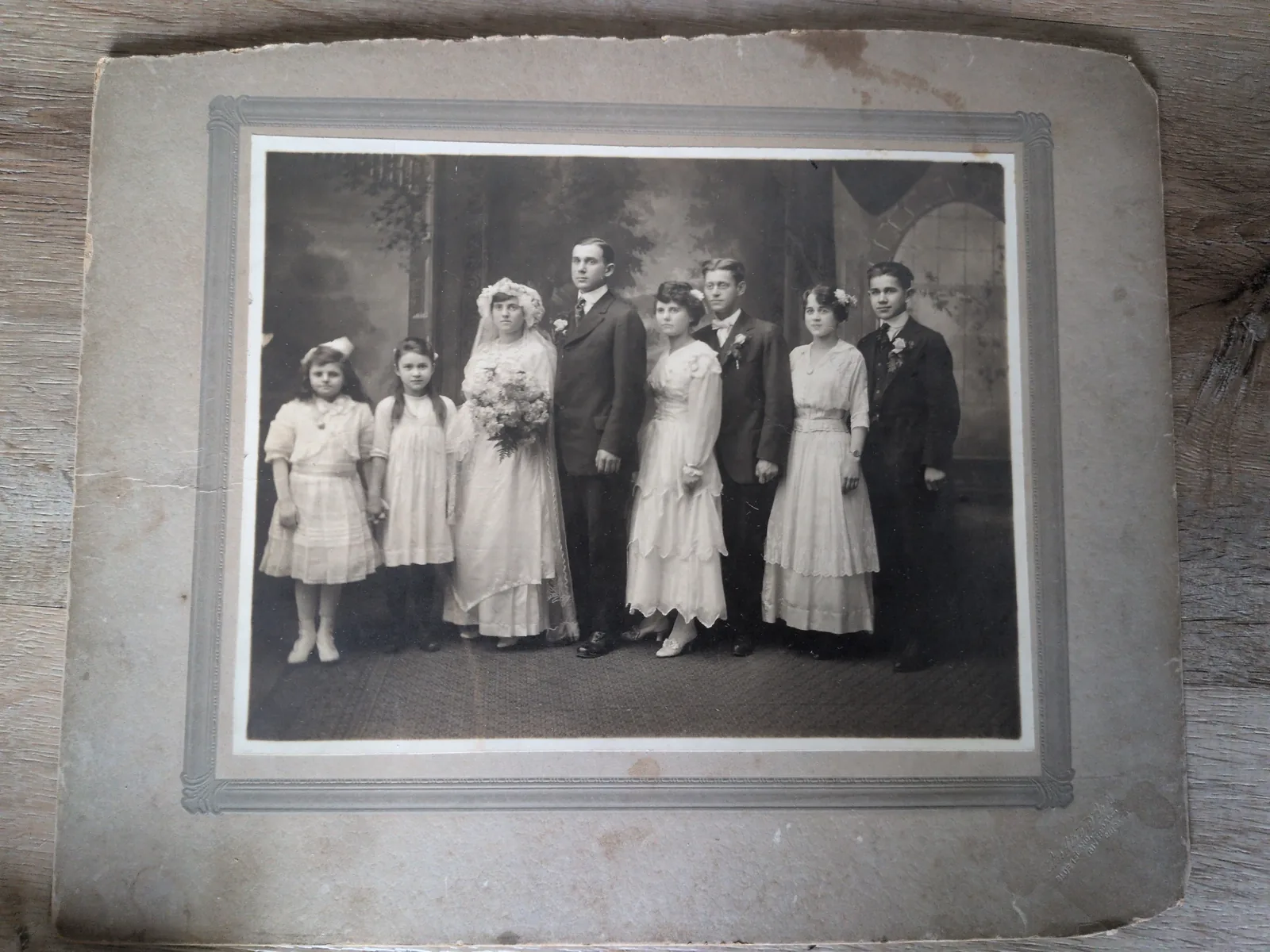
Who are these people? These faces are in our family’s photographs, but we’ve lost their names. This wedding party sat for a studio portrait more than a century ago — do you recognize anyone? Even a guess at the branch, the town, or the year helps. Tap a photo to enlarge it, then tell me who they are, and when, where, and why the photo was taken.
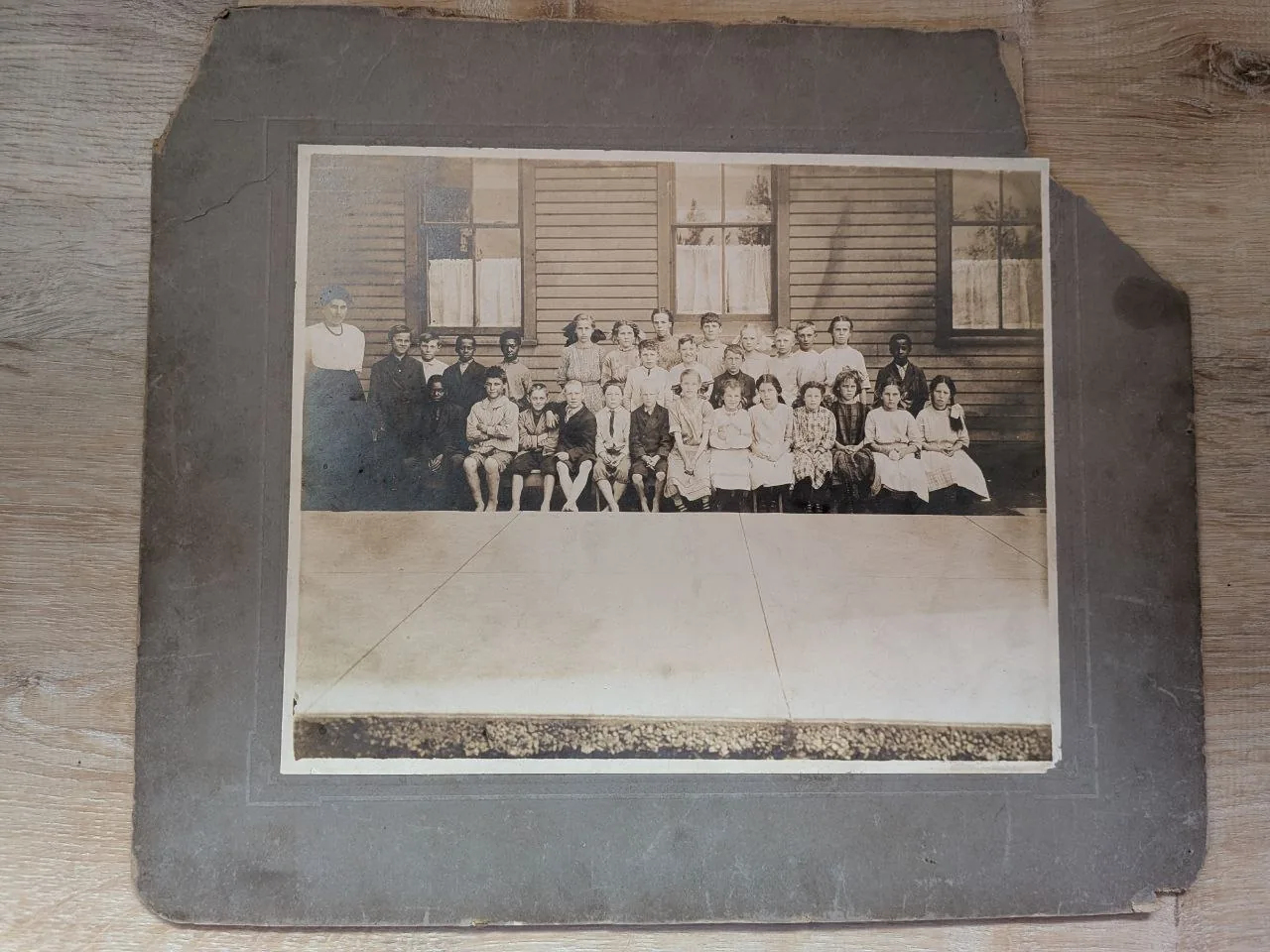
unidentified
BrennanSchool1910s
Found with: Family photos (Steven Almeroth) — provenance TBD
Era: c. 1910s–early 1920s
Notes: School group portrait on a grey card mount, corners knocked and the board flaking: roughly thirty pupils and one young woman teacher (left, in a white blouse and dark skirt) posed on the concrete apron of a clapboard schoolhouse, three double-hung windows with half-curtains behind them. Boys in dark suits and knee pants, girls in white and gingham dresses; several Black children among the class, so not a segregated district — a hint at where this was taken. No studio stamp, no inscription. The clothing and hair put it around 1912–1922.
unidentified
BrennanWedding1910s
Found with: Family photos (Steven Almeroth) — provenance TBD
Era: c. 1910s
Notes: Studio wedding portrait mounted on a grey cabinet card: bride & groom center, two young girls at left, an attendant couple and a second couple at right — eight people. Blind-embossed studio stamp, bottom-right, three lines: cursive studio name (illegible) / a street-address line / a city that reads "RIVERSIDE" (state uncertain — Riverside, IL near the Chicago family, or Riverside, CA). Card edges worn; some foxing.